
The GCC switchgear market is growing steadily rather than spectacularly — but the composition of that demand is changing far faster than the headline growth rate suggests. Regional interconnection, utility-scale renewables and giga-project electrification are pulling the market toward higher voltages, higher fault levels and, increasingly, SF6-free equipment.
Here is what the numbers say, why published estimates disagree so sharply, and what it means if you are specifying or sourcing switchgear in the region this year.
How big is the GCC switchgear market?
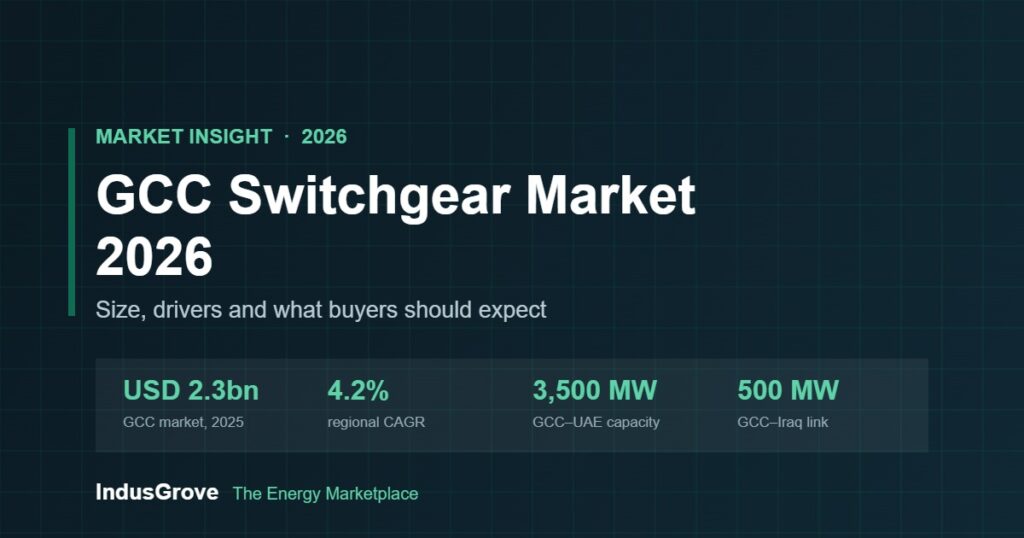
Published estimates put the GCC switchgear market at roughly USD 2.3 billion in 2025, projected to reach about USD 3.4 billion by 2034 — a compound annual growth rate in the region of 4.2%.
Country-level forecasts run higher:
- Saudi Arabia — estimated at USD 2.52 billion in 2025, forecast to reach USD 3.56 billion by 2031 at a CAGR of about 5.9%
- UAE — forecast to grow at roughly 6.8% CAGR from 2026 to 2033
Why do the published figures disagree?
You will have noticed the problem: one source puts the entire GCC market at USD 2.3 billion, while another puts Saudi Arabia alone at USD 2.5 billion. Both cannot be right on the same definition.
They are not using the same definition. Market reports in this sector differ on:
- Voltage scope — whether LV switchgear and final distribution boards are counted, or only MV and HV
- Whether installation, engineering and commissioning are included or only equipment ex-works
- Whether switchgear inside packaged substations, RMUs and OEM assemblies is counted separately or absorbed into another category
- Currency conversion timing and the treatment of intra-regional trade
The practical conclusion for a buyer or a supplier is straightforward: use these figures for direction, not for magnitude. The consistent signal across every source is mid-single-digit growth with the Gulf’s two largest economies running ahead of the regional average. That is the finding worth planning around.
What is actually driving demand?
Regional grid interconnection
The GCC Interconnection Authority is in the middle of the most significant expansion since the original grid was energised, with a reported investment programme of around USD 3.5 billion covering regional links and renewables integration.
Three projects matter for switchgear demand:
- GCC–Iraq — roughly 500 MW to southern Iraq via a 295 km, 400 kV double-circuit overhead line from Al-Wafrah substation in Kuwait to Al-Faw in Iraq. The GCC grid’s first external connection beyond the region.
- GCC–UAE expansion — raising transfer capacity from 2,400 MW to 3,500 MW, via a 96 km 400 kV line from Salwa to Al-Sila, together with 400 kV switchgear expansion and shunt reactor installation
- GCC–Oman direct interconnection, now under way
Jordan, Egypt and potentially Syria are under discussion for the longer term. Each new link means new 400 kV bays, and each capacity increase raises the fault level that downstream equipment must withstand.
Renewables integration
Utility-scale solar and wind across Saudi Arabia and the UAE require collection substations, MV switchgear at the array and reinforcement of the 132 kV to 380 kV transmission backbone that carries the output to load centres. This is a different demand profile from load growth: it adds switchgear at points on the network where there was previously nothing at all.
Giga-projects and economic diversification
NEOM and the wider Vision 2030 programme, along with comparable diversification investment across the region, create greenfield distribution networks at a scale that rarely occurs in mature markets — and greenfield networks are specified to current standards rather than matched to a legacy installed base.
What does this mean for switchgear specification?
SF6 is becoming a procurement question, not just a technical one
SF6 remains the best insulating and arc-quenching medium available, and it is also the most potent greenhouse gas in commercial use — around 23,500 times the global warming potential of CO₂, with an atmospheric lifetime of roughly 3,200 years.
Regulatory pressure originates in Europe, but it reaches the Gulf through two routes that matter regardless of local rules: equipment manufacturers are moving their product roadmaps, and internationally financed projects increasingly carry environmental conditions. An asset specified today has a forty-year life. Solid dielectric and alternative-gas equipment is worth evaluating now, even where nothing currently compels it.
For the existing SF6 fleet, the practical requirement is gas accounting, recovery and quality verification — which is a gas handling equipment question as much as a switchgear one.
Fault levels are rising
More generation and stronger interconnection mean higher prospective short-circuit currents. Short-time withstand rating is the parameter most often carried forward unchanged from a previous specification, and it is the one least forgiving of being wrong. Check it against a current network study rather than against the last purchase order.
Local content requirements
Saudi Arabia in particular continues to tighten local content expectations on utility procurement. This is reshaping supply chains toward regional manufacturing and assembly, and it affects lead times, qualification requirements and which manufacturers can realistically bid.
What should buyers do differently in 2026?
- Re-verify fault levels before repeating an earlier specification. Interconnection changes them.
- Ask manufacturers directly about their SF6-free roadmap, even if you buy SF6 equipment today. The answer tells you about spares and support in fifteen years.
- Specify ambient conditions honestly. Gulf design temperatures derate equipment significantly, and reference values do not describe a switchyard in August.
- Plan lead times against local content rules, not against ex-works quotations from outside the region.
- Treat internal arc classification as a safety specification, with rating and duration stated explicitly rather than assumed.
Frequently asked questions
What is the GCC switchgear market worth?
Published estimates centre on roughly USD 2.3 billion for the GCC in 2025, rising to around USD 3.4 billion by 2034. Country-level estimates use different scopes and are not directly comparable — treat all such figures as indicative of direction rather than precise magnitude.
Which GCC country is growing fastest?
On published forecasts the UAE shows the highest growth rate at around 6.8% CAGR, with Saudi Arabia close behind at about 5.9% and both ahead of the regional average.
Is SF6 switchgear being banned in the GCC?
There is no regional ban. The pressure is arriving indirectly, through manufacturer product roadmaps and the environmental conditions attached to internationally financed projects. Given a forty-year asset life, the alternatives are worth evaluating now.
What is the GCC–Iraq interconnection?
A 400 kV double-circuit link of about 295 km from Al-Wafrah substation in Kuwait to Al-Faw in southern Iraq, rated at approximately 500 MW. It is the GCC grid’s first connection outside the region.
Related reading
- Ring Main Units (RMU): specification guide
- Prefabricated Substations: specification guide
- SF6 Gas Handling Equipment
- Lightning Protection and Surge Arresters
Browse current listings under Substation & Switchgear, Medium Voltage Switchgear, Ring Main Units and Transmission Lines & Infrastructure.
Sourcing switchgear for a GCC project? Send the system voltage, fault level and duration, configuration and site ambient conditions, and IndusGrove will help identify suitable manufacturers.